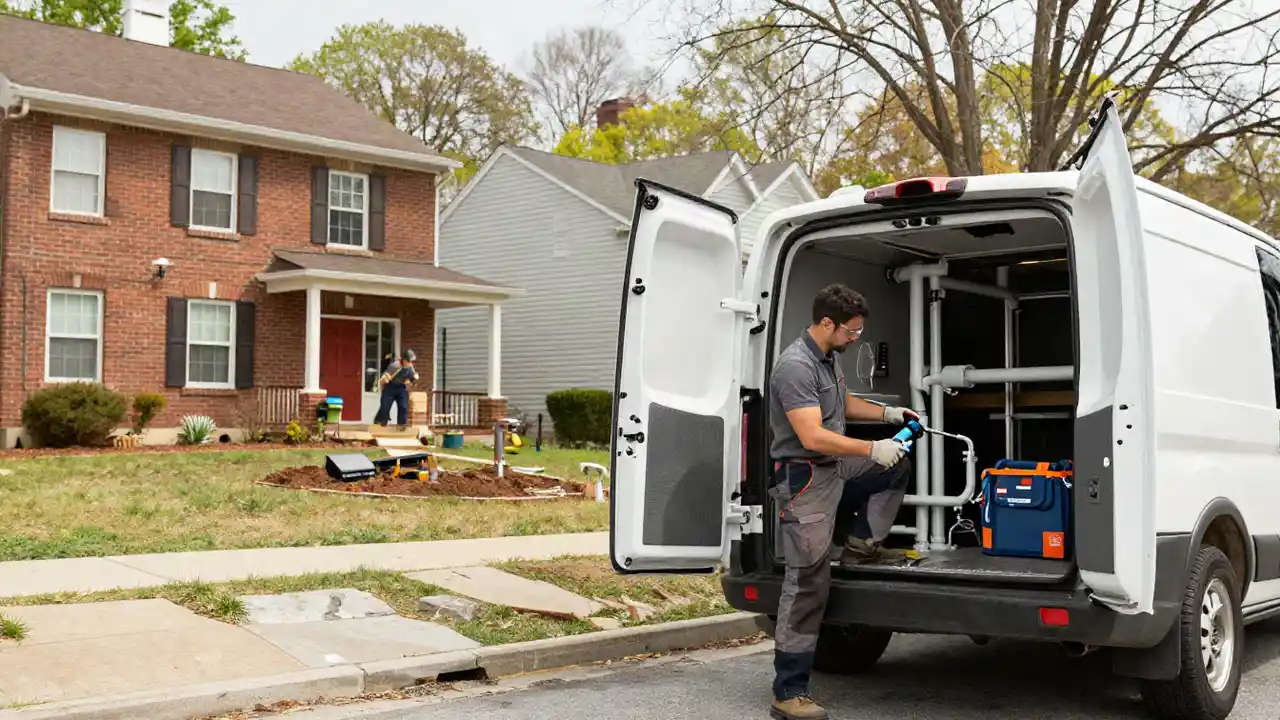
Start with the year: if your Donelson home was built between 1945 and 1972, Orangeburg is a real possibility — the material was used across this metro in that window. The certain answer is a camera run: Orangeburg shows as a dark, fibrous pipe, often blistered or visibly ovalled, and once you've seen yours on screen you'll never mistake it for anything else.
Drain Cleaning Nashville Pros
Cast iron in the failure window
Quick answer
what's special about Donelson drains? The era. A 1950s–60s ranch typically sits on cast iron, Orangeburg, or a run of both — and both materials are at or past their published working lives now. Cleaning still fixes clogs in sound pipe. It cannot fix an Orangeburg line that has ovalled flat, and the only way to know which material — and which condition — your house has is a camera: $225, included with a main line clean at $249, the video yours either way.
The cast-iron half of Donelson behaves like cast iron everywhere, with the volume turned up by arithmetic. Published lifespans for the material conflict — the guides in our research put cast iron anywhere from about 50 to 100 years — but a 1960 ranch's original line is 60-odd years old, which puts it inside the failure window under every published range's lower half. The mechanism is inside-out: rust and mineral scale narrow the bore, the roughened wall catches what a smooth pipe would pass, and the line starts clogging on things it swallowed without complaint for decades. Where the camera shows scale rather than a soft clog, the fix is descaling — a chain-flail head and a jetter stripping the pipe back toward bare wall — and where it shows the bottom of the pipe rotted through, the channel-rot verdict, no cleaning conversation survives the footage. That's a repair page's territory, and the footage is what sends you there honestly.
Drain Cleaning Nashville Pros
Orangeburg: the pipe with four names, in Donelson's ground
Orangeburg is the material question underneath this neighbourhood, so here it is plainly. Between the 1940s and the early 1970s, when clay and iron were short or dear, builders laid a pipe pressed from wood pulp and coal-tar pitch — bituminous fibre, in the trade's words. It was cheap, light, and expected to last around fifty years. It absorbs moisture as it ages, softens, blisters and peels inside, and slowly ovals under the soil until the round pipe it was is an egg shape that catches everything. Every Orangeburg lateral still in the ground is past its design life now; the only live question on any given street is how far the deformation has gone.
Homeowners meet it under so many names that our forum research found four spellings for it — "orange bird," "orange pipe," "stromburg," and only sometimes Orangeburg — which is why so many Donelson owners don't know what they have until a piece of it comes up in a trench or a camera shows the bore closing. The metro evidence that the material was actually used here is real: a Hendersonville plumber's page describes post-dam growth there — 1950s through early 1970s — running to clay tile, cast iron or Orangeburg, and Donelson's building wave is the same wave on the same side of the same boom. What we will not do is claim a count — nobody has surveyed Donelson's laterals — which is why the honest sentence is the conditional one: if your ranch went up between 1945 and 1972, your lateral is in the window to check. The check is the camera. A round Orangeburg line with sound walls can be cleaned and monitored; an ovalled one cannot be snaked back to health, and our Orangeburg pipe guide works the whole material — the spellings, the failure sequence, and the yearly-snake counter-case for lines that are still round — while the trenchless sewer repair page covers what replacement looks like when the footage says it's time, from $95 per linear foot.
Drain Cleaning Nashville Pros
The street-age split, and Whispering Hills next door
Donelson's streets weren't all poured in one year, and the drain work respects the split: the earlier post-war streets skew to the Orangeburg window, the later ones to cast iron and then the transition years. We don't pretend to a survey we haven't done — the camera on your run answers for your house in one visit, and the era tells us where to expect the argument, not what the verdict is. Next door, Whispering Hills shares this building wave and has its own page for its own stock; the two neighbourhoods' pipes are cousins, not twins, and the pages are written that way.
What a Donelson call looks like from us: the sewer camera inspection first, the material and condition named from footage, then the fork in writing — a clean at $249 with the camera before and after and our written 1-year warranty where the pipe is sound, or the repair conversation where it isn't, with the clean-versus-replace maths done on your numbers rather than a sales script. Book it at (615) 555-0134. If the whole street is slow at once, that's the public main — Metro Water Services, 615-862-4600 option 3, free investigation — and we'll say so before we sell you anything.
Both, depending on its shape — which is the whole point of looking first. A round, intact Orangeburg lateral can be cleaned carefully and monitored. A line that has ovalled or flattened can't be cleaned back to round, and snaking a collapsing pipe is money spent postponing a replacement. The footage decides; anyone who answers before looking is guessing with your money.
Quite possibly — a cast-iron line of that age is inside its failure window under most published lifespan ranges, and internal scale narrows it until ordinary use clogs it. The camera distinguishes scale (descaling can restore much of the bore) from channel rot (it can't). Same symptom, opposite answers, one look.
In this building wave, it's the highest-value $225 in the transaction. The scope identifies the material — cast iron, Orangeburg, clay, PVC — and grades its condition while the price can still move. A flattened Orangeburg lateral discovered after closing is a five-figure surprise; discovered during inspection, it's a negotiation.
Outside Donelson?
Nearby areas we serve from Donelson
01East NashvilleDrain repair in East Nashville starts from a fact no amount of cleaning changes: a large share of the housing stock east of the river was standing before the Second World War, and the pipes under it are the pipes of that era.↗02Sylvan ParkDrain cleaning Sylvan Park TN work has a rhythm the rest of the city doesn't, and the neighbourhood's biggest competitor says so on its own website.↗03Whispering HillsDrain cleaning Whispering Hills TN is a page that exists because the search data says the neighbourhood asks for itself, by name — and because its pipes genuinely aren't the same story as the rest of the city.↗04MadisonEvery other neighbourhood page on this site can end a certain kind of paragraph with Metro Water Services' number.↗05GoodlettsvilleDrain cleaning Goodlettsville searches sit on a line most homeowners don't know is under them: Goodlettsville straddles two counties.↗06BrentwoodDrain cleaning services in Brentwood TN start from a different place than the rest of this site, and the page should say so in its first breath: Brentwood is Williamson County, not Davidson.↗